Modernizing Mailjet’s Email Editor
Mailjet's email editor sat at the heart of the product, directly shaping onboarding, activation, and retention. But research revealed that the editor wasn't failing because of missing features. It was failing because users couldn't predict what it would do next. Invisible styling scope, no recovery paths, and ambiguous system feedback were quietly eroding confidence at scale. For the most feature-complete editor in the Sinch product family, that gap between capability and user confidence was the problem worth solving.
I led research strategy and experience definition across discovery and validation, synthesizing 9,300+ NPS verbatims, card sorting, competitive benchmarking, and usability testing into a coherent system direction. The work reframed how branding, editing, and trust should function as a cohesive system. Through research synthesis, concept development, and prototype validation, we established a direction for modernizing the editor around predictability, transparency, and user confidence.
competitive editors benchmarked
content blocks assesed
settings tested
task success in prototype validation
Timeline:
Research ran from Oct–Dec 2025
Role:
Lead UX Researcher · Design Partner
Mailjet's drag-and-drop editor sat at the center of the customer experience and, for many users, it delivered on its promise. Across thousands of NPS responses, customers regularly described the editor as easy to use, approachable, and quick to get started with.
But that experience began to break down as workflows became more complex.
Over seven months of research spanning 9,300+ NPS responses, customer interviews, support feedback, usability testing, and competitive analysis, the same friction points surfaced repeatedly. Users struggled with lost work due to a lack of autosave, rigid templates that limited customization, unclear error states, and performance issues that undermined confidence in the editing experience.
“I spent more than 2 hours configuring a campaign… and lost all my progress because there no autosave system.”
“Rigid templates and UX compared to competitors."
"Frontend technically outdated, editor outdated."
The challenge wasn't simply missing features or visual aging. Users often couldn't tell where controls lived, how styling changes would propagate, whether an action had succeeded, or how to recover when something went wrong. The editor was functional, but its behavior wasn't always clear.
At the same time, competitive benchmarking revealed that most modern email editors had converged around similar interface patterns and feature sets. Visual modernization alone was unlikely to create meaningful differentiation.
The opportunity was to improve trust in the editing experience itself: making system behavior more transparent, reducing uncertainty, and helping users feel confident as they created, edited, and scaled their campaigns.
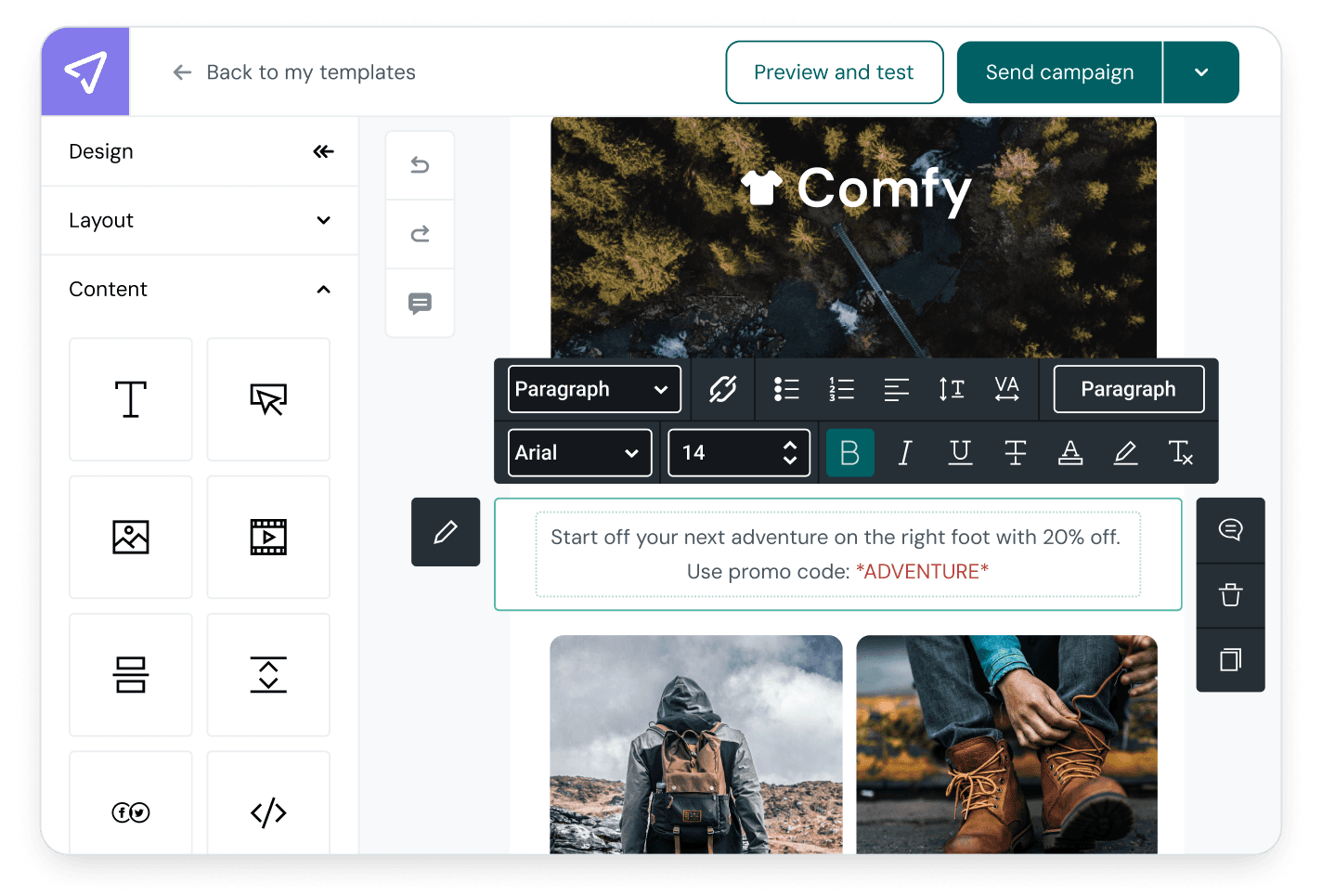
Legacy editor experience
I led this work from early discovery through system definition and validation, partnering closely with product design and engineering to translate research into durable experience principles and behavior models.
My role extended beyond identifying usability issues to defining how the editor should behave as a system — particularly around branding, inheritance, and trust feedback. I owned research strategy, synthesized signals across multiple sources, and articulated the design intent that aligned teams around a shared north star.
Experience strategy and design intent definition
Research planning and execution across discovery and validation
Moderated and unmoderated usability testing (wireframes and prototypes)
Unmoderated card sorting to map user mental models
Competitive benchmarking across 12 tools and pattern analysis
Cross-signal synthesis (NPS, support tickets, interviews, usability)
System behavior and IA recommendations
Microcopy and user messaging strategy
Engineering alignment, feasibility tradeoffs, and documentation support
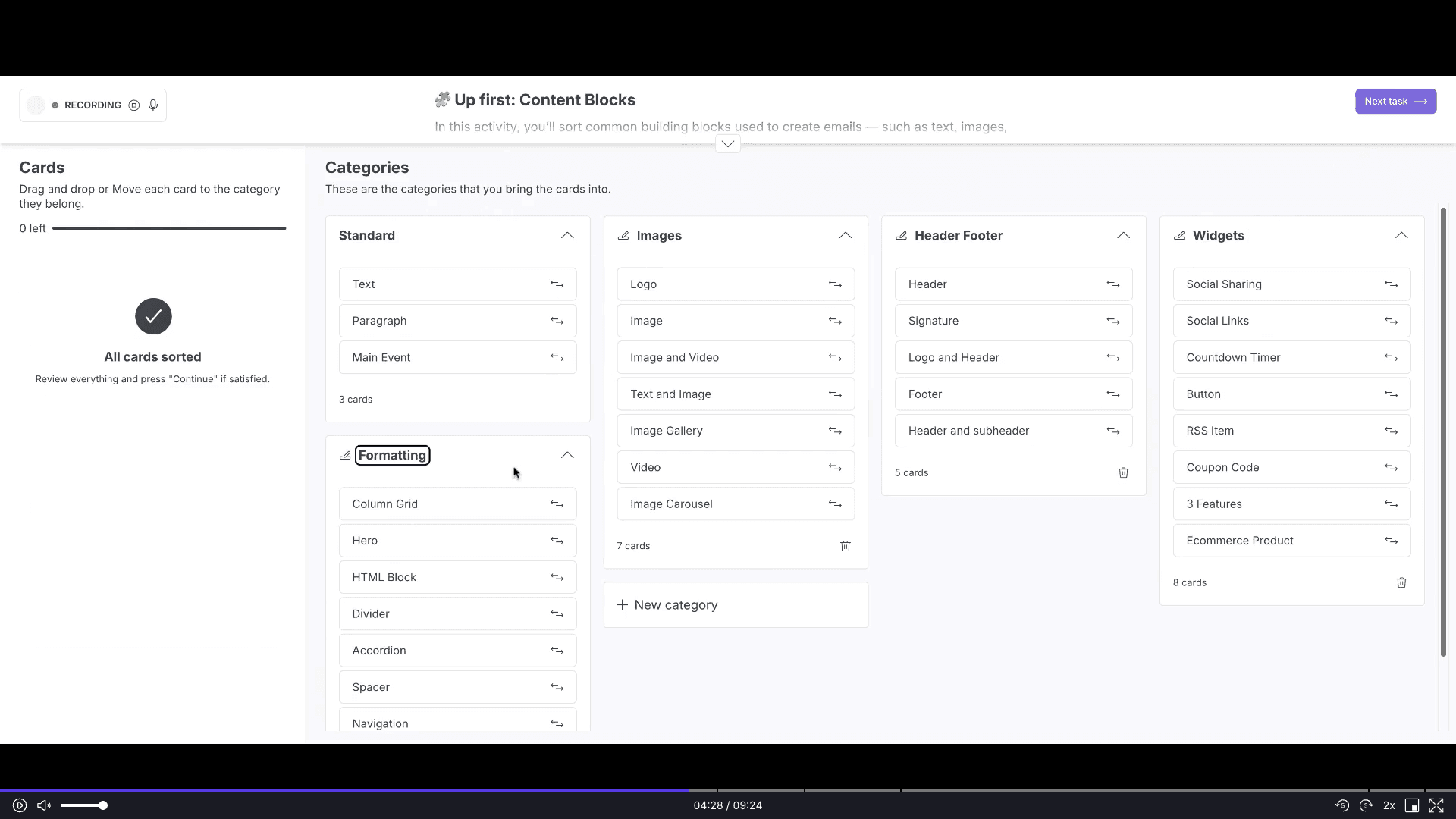
What participants were shown
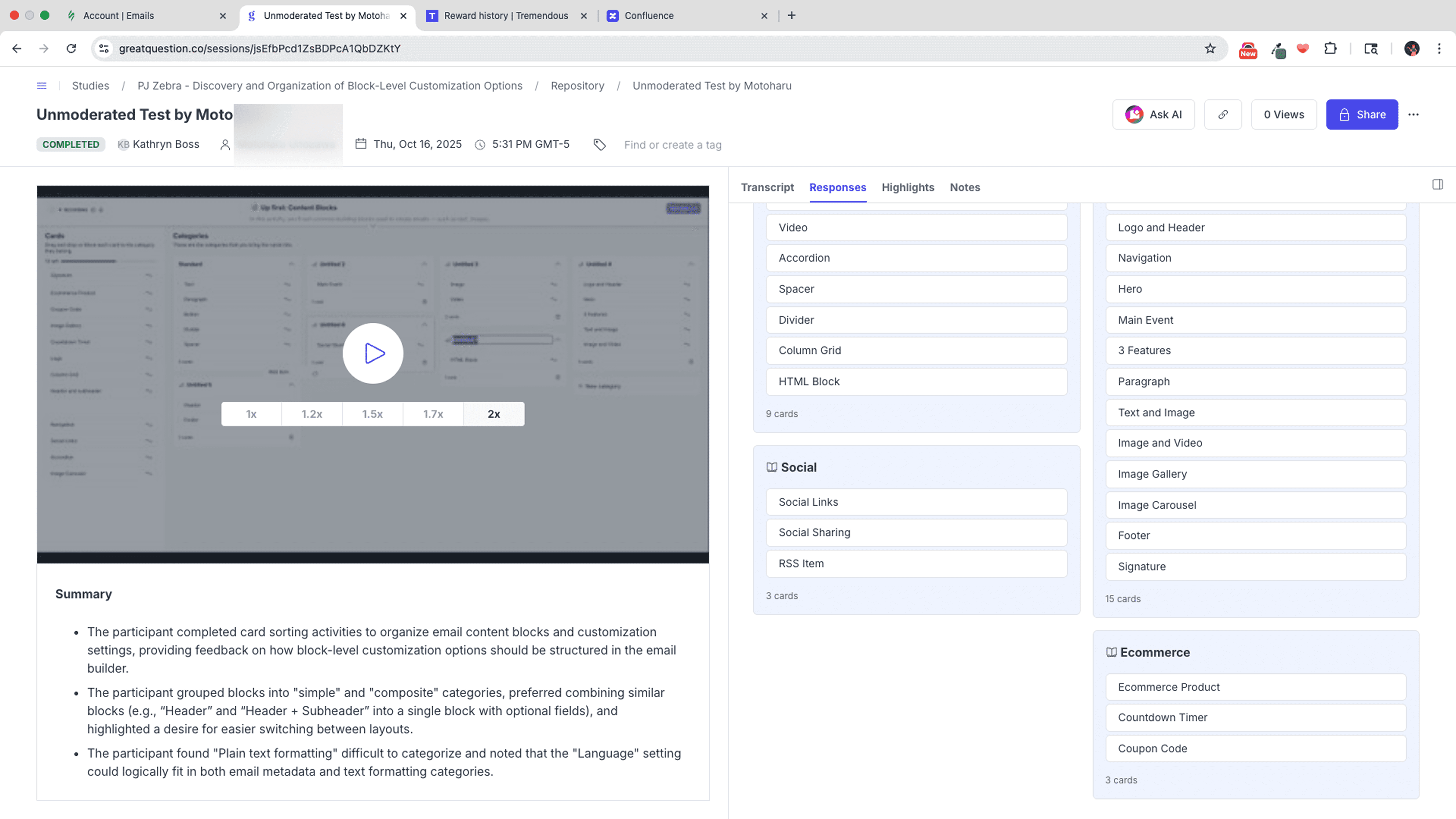
What we saw
Competitive Benchmarking (12 Tools)
Competitive analysis evaluated 12 email editors across 16 criteria — spanning builder discoverability, style model and toolbar UX, template flexibility, Brand Kit application, AI assistance, performance, and publication workflow. Tools were scored against a structured rubric and ranked by overall experience quality.
The findings revealed a market largely converged around similar block-based editing patterns. Most tools competed on feature count or visual polish. The clearest gap wasn't capability — it was how confidently users could understand what the editor was doing, control how styles applied, and recover when something went wrong. Transparency, recoverability, and trust were consistently underinvested across the competitive landscape.
Findings were synthesized into a strategic readout for stakeholders that framed the opportunity: not another block editor, but an experience defined by intelligence, design flexibility, and system clarity — one that users would find meaningfully better, not incrementally improved. The readout aligned the team around a north star for the redesign direction and established the research foundation for the work that followed.

Side-by-side evaluation of competitors revealed where the market had converged and where it hadn't.
Customer Interviews (Workflow Reality Check)
Semi-structured interviews with external customers across technical and non-technical roles confirmed the earlier signals. Users compensate for editor uncertainty with external tools — Canva, ChatGPT, Email on Acid. Repetitive workflows magnify even small inefficiencies. AI is valued as an assistant for summarization, debugging, and optimization — not as a creative replacement. Trust and predictability matter more than flexibility alone.
Usability Testing (Interactive Prototype)
Unmoderated, think-aloud usability tests used an interactive Figma Make prototype to validate IA, mental-model alignment, and trust-related interactions. Task success rates on core flows ran at 80% — preview before sending, adjust section background, add subject line, use the AI assistant. Friction most often occurred during mid-flow editing and system feedback moments, not initial discoverability. When frustration appeared, it was tied to unclear system responses rather than not knowing what to do next.
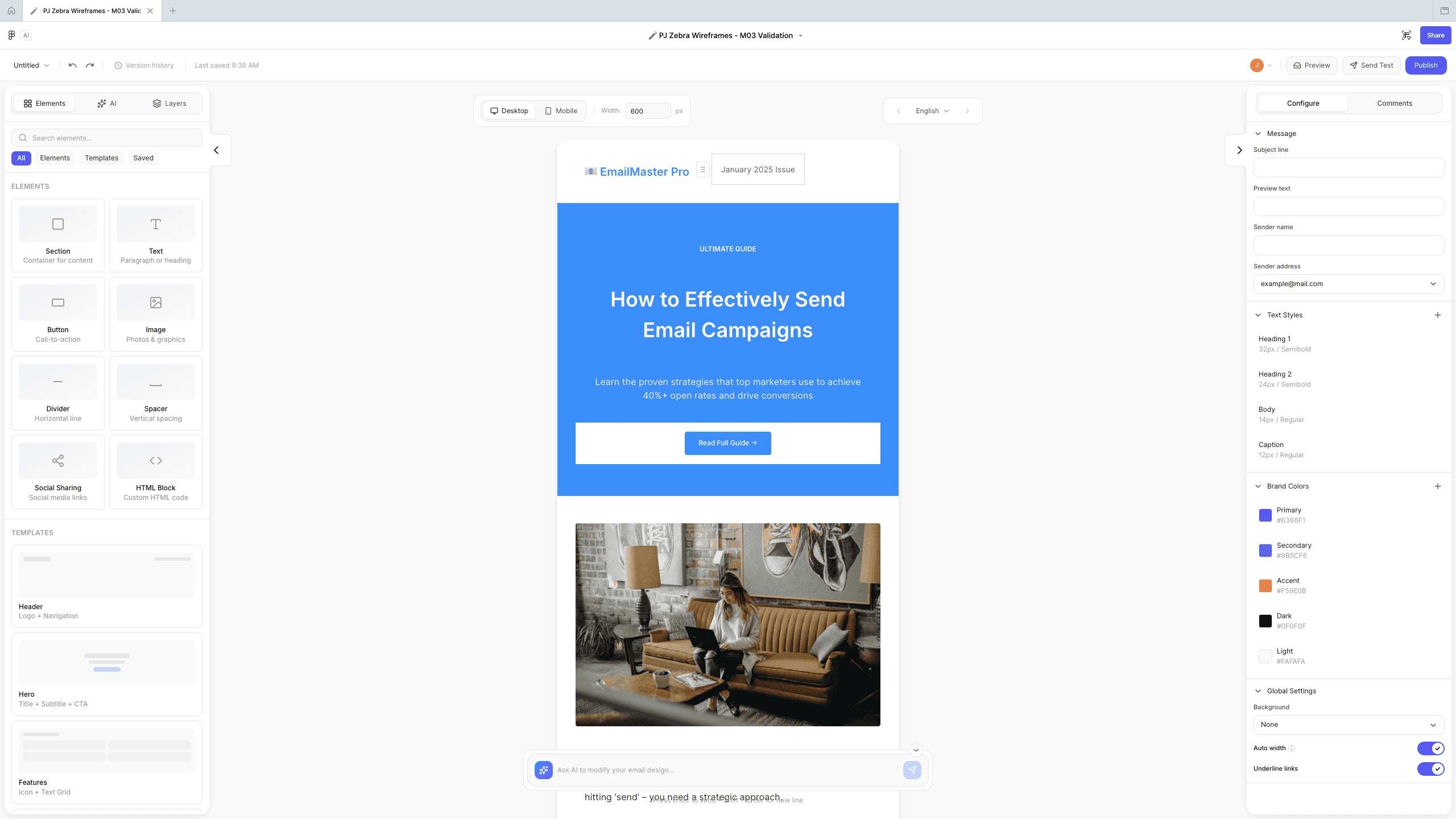
Prototype validation through early Figma Make user testing
Evidence Note
Evidence is drawn from internal usability testing, NPS analysis, and competitive research conducted at Mailjet. Artifacts shown are anonymized.
Each design decision translated a specific research finding into concrete system behavior. The goal was to reduce ambiguity, increase predictability, and embed trust directly into the editing workflow.
Tabbed Content | Style | Settings Panels (Mental Model Mapping)
Research insight: Users mentally separate what they’re editing from how it looks and how it behaves — but the editor treated all three as one undifferentiated surface.
System decision: Organized controls into clearly scoped Content, Style, and Settings panels to align with user mental models and reduce cognitive load during editing.
Impact: Reduced guesswork and prevented accidental cross-scope changes, especially during mid-flow edits.

Usability testing setup shown to participants in Great Question
Tiered Block Library (Standard vs. Pre-Built)
Research insight: Pre-built blocks accelerate creation but introduce hesitation when editability is unclear. Users didn’t know what they could and couldn’t change.
System decision: Separated standard blocks from pre-built blocks to make levels of flexibility and control explicit.
Impact: Preserved editing speed while restoring confidence — allowing users to choose intentionally between structure and freedom.
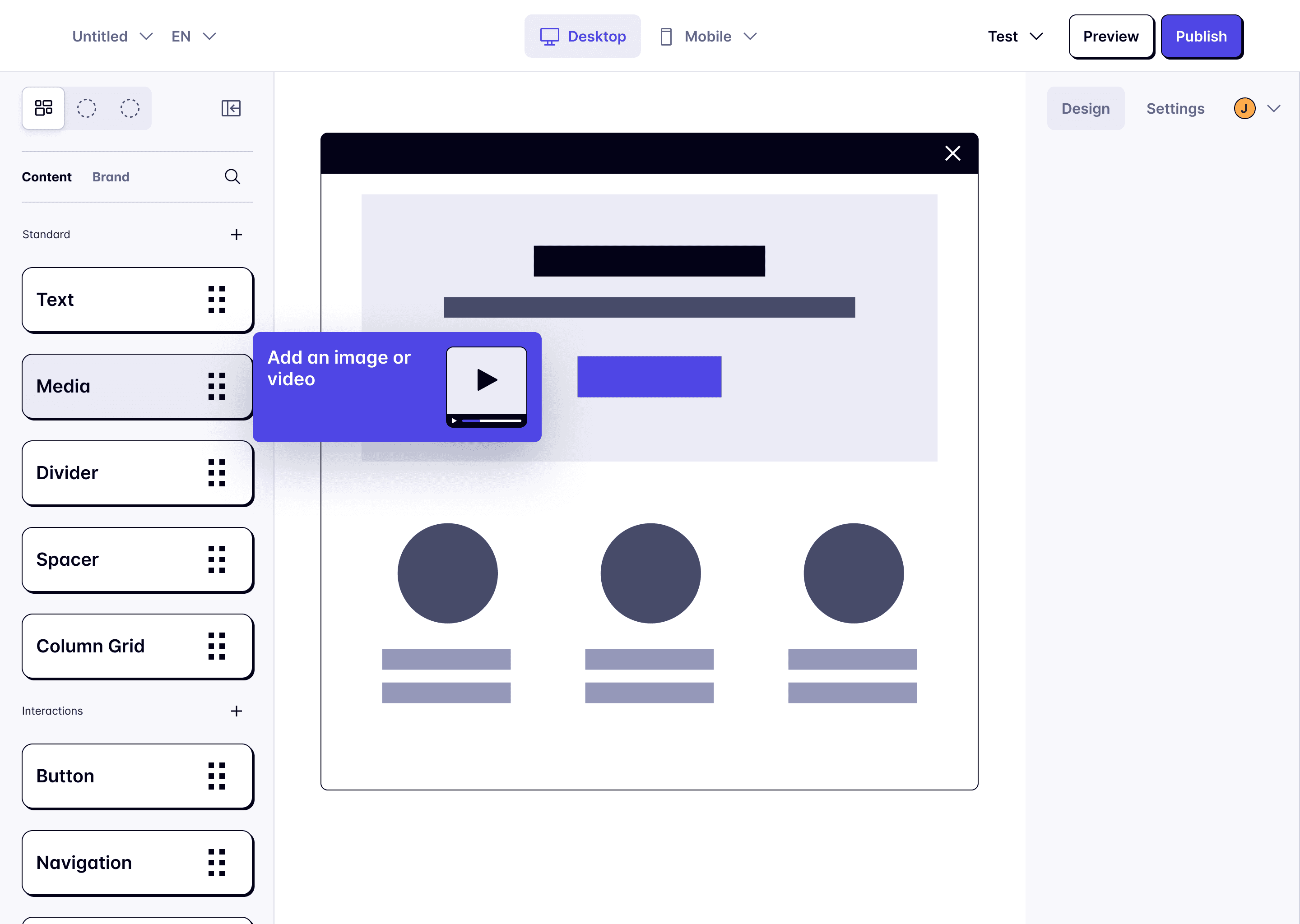
Early concept for new IA
Testing Library and Post-Action Feedback (Matching Expectactions)
Research insight: Autosave, testing, and recovery were perceived as business-critical trust signals. Users relied on external tools because the editor gave no confirmation that actions had succeeded.
System decision: Improved visibility into testing history and post-action system feedback — save, send, and test confirmations made explicit.
Impact: Reduced reliance on external validation tools and increased the confidence to proceed without second-guessing.

Testing tools designed for confidence
Evidence Note
Evidence is drawn from internal usability testing, NPS analysis, and competitive research conducted at Mailjet. Artifacts shown are anonymized.
Research consistently validated the proposed direction.
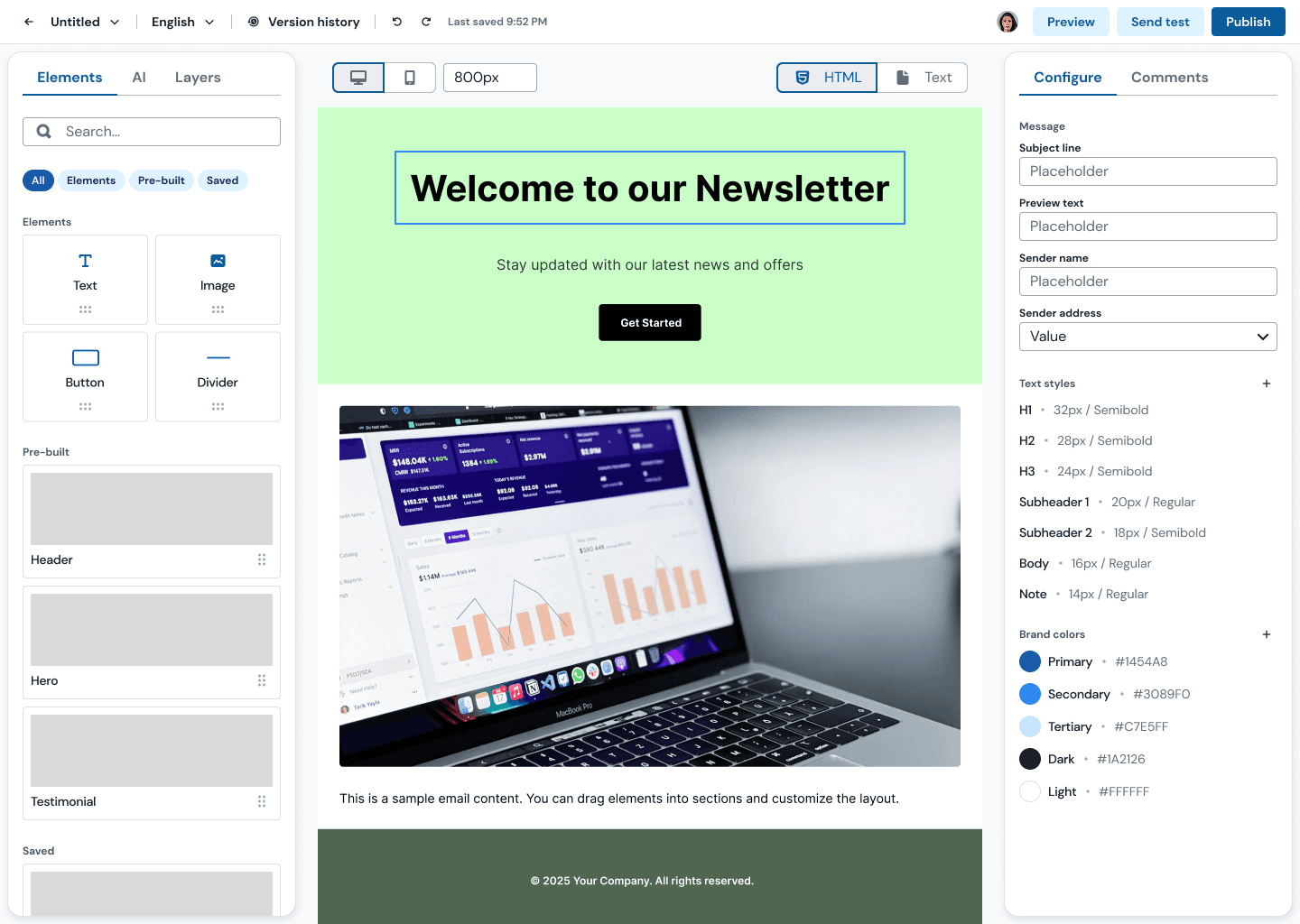
Recommended product direction following discovery and validation
Users were able to navigate the proposed architecture with confidence, and card-sorting exercises reinforced the separation between content, styling, and settings. Across usability testing, customer feedback, support data, and competitive analysis, the same pattern emerged: users struggled less with missing features than with uncertainty about how the system behaved.
This shifted the opportunity from feature expansion to trust-building. The strongest improvements came from making system behavior more visible, reducing ambiguity, and giving users clearer recovery paths when mistakes occurred.
This work addressed foundational breakdowns in how users understand, trust, and scale their work within the Mailjet editor ecosystem. The goal was to reframe the editor from a collection of features into a trust-driven system — where branding, templates, and user actions behave predictably across contexts.
Rather than optimizing isolated interactions, this project focused on modernizing the mental model of the editor itself — clarifying what’s happening, where actions apply, and how users recover when things go wrong. These moments quietly determine whether users feel confident enough to proceed, experiment, and scale their work over time.
The work was strategic in five concrete ways:
Excavated real user mental models, revealing where legacy information architecture, invisible styling scope, and ambiguous system states caused hesitation, rework, and errors during creation
Addressed competitive gaps where other editors optimize for speed or novelty but underinvest in predictability, recovery, and trust — especially for teams working at scale
Reframed reliability as a UX surface, embedding clarity through guardrails, visible scope, autosave signals, and reversible actions rather than relying on post-hoc documentation
Established a set of reusable experience principles around transparency, recovery, and trust that could inform adjacent product experiences
Directly targeted churn drivers surfaced through research and support feedback — particularly moments where users felt unsure, blocked, or afraid to proceed
The proposed direction wasn’t focused on visual modernization alone. It was designed to create a more predictable, trustworthy editing experience that could scale with user needs.
The biggest lesson from this project was realizing the problem wasn't really about features.
When we started, it was easy to assume the editor needed a more modern UI, new capabilities, or a better component library. But the research pointed to something deeper. Users weren't struggling because features were missing. They were struggling because they weren't always confident in how the editor would behave.
That shifted the conversation from "How do we improve the editor?" to "How do we make the editor feel more predictable and trustworthy?" Once we framed the problem that way, design decisions became much clearer. Every change could be evaluated against the same question: does this reduce uncertainty for the user?
This project also reinforced the value of looking at multiple research signals together. No single study told the whole story. The patterns became clear when we combined NPS feedback, usability testing, information architecture exercises, and competitive analysis. When thousands of customer comments, usability participants, and competitive benchmarks all point to the same underlying issue, it's worth paying attention.
Several areas remain opportunities for future exploration, including styling inheritance, composite block editing, and version history, all of which surfaced as higher-friction areas during research.

For the most feature-complete editor in the Sinch product family, trust became the opportunity